Learn from bounded experience.
Preserve sources, provenance, permissions, and a reproducible candidate update.
Humanus brings the computer, servers, AI, custom network, and manufacturing system into one engineering program.
This roadmap replaces the earlier appliance-first, $100,000 / 24-week proposal. It is a development pathway; no fabrication release, delivery date, or production cost is asserted.
Physical element → Cell → array → computer & server → collective-learning network.
Materials, production, testing, maintenance, and repair develop alongside every stage.
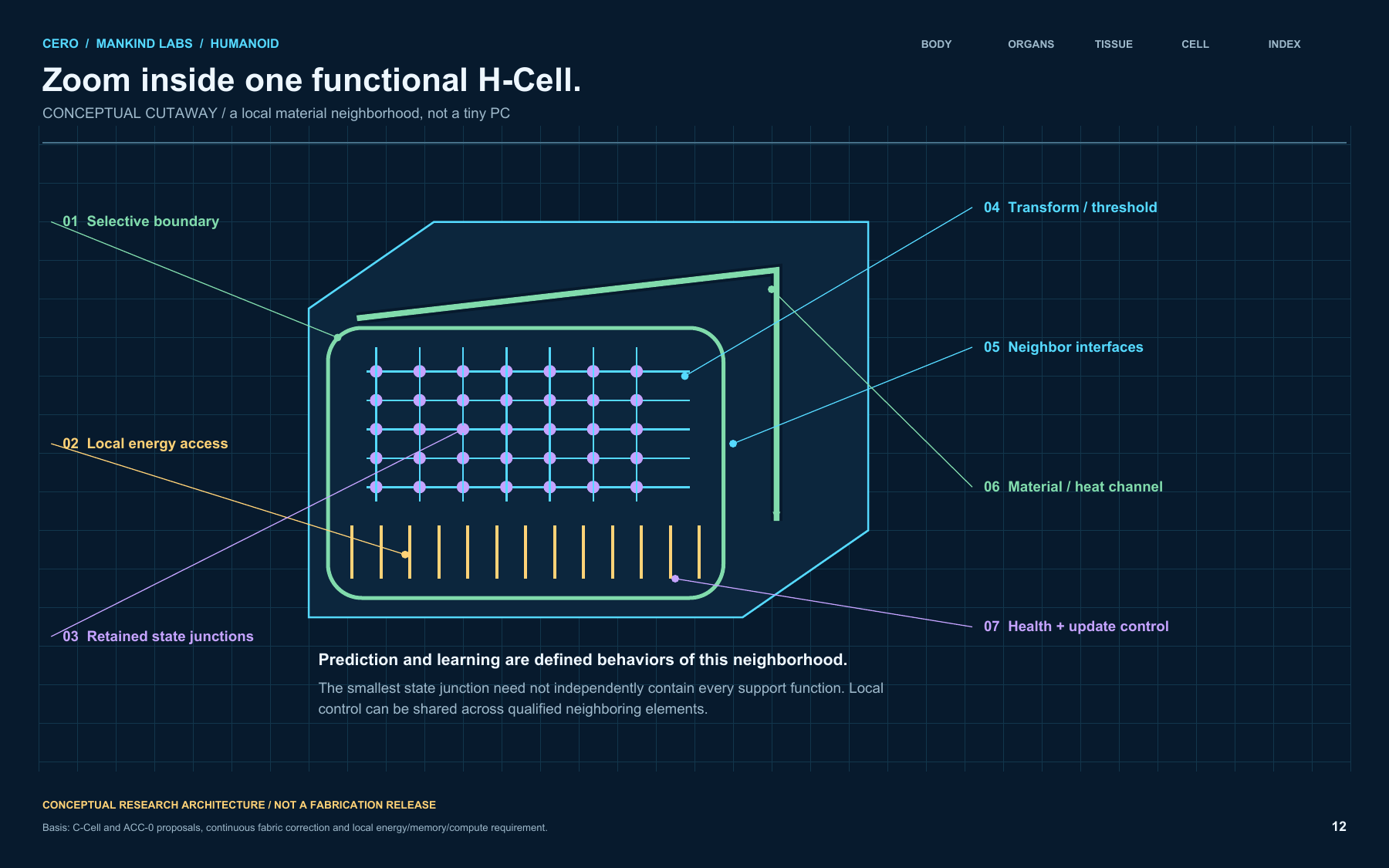
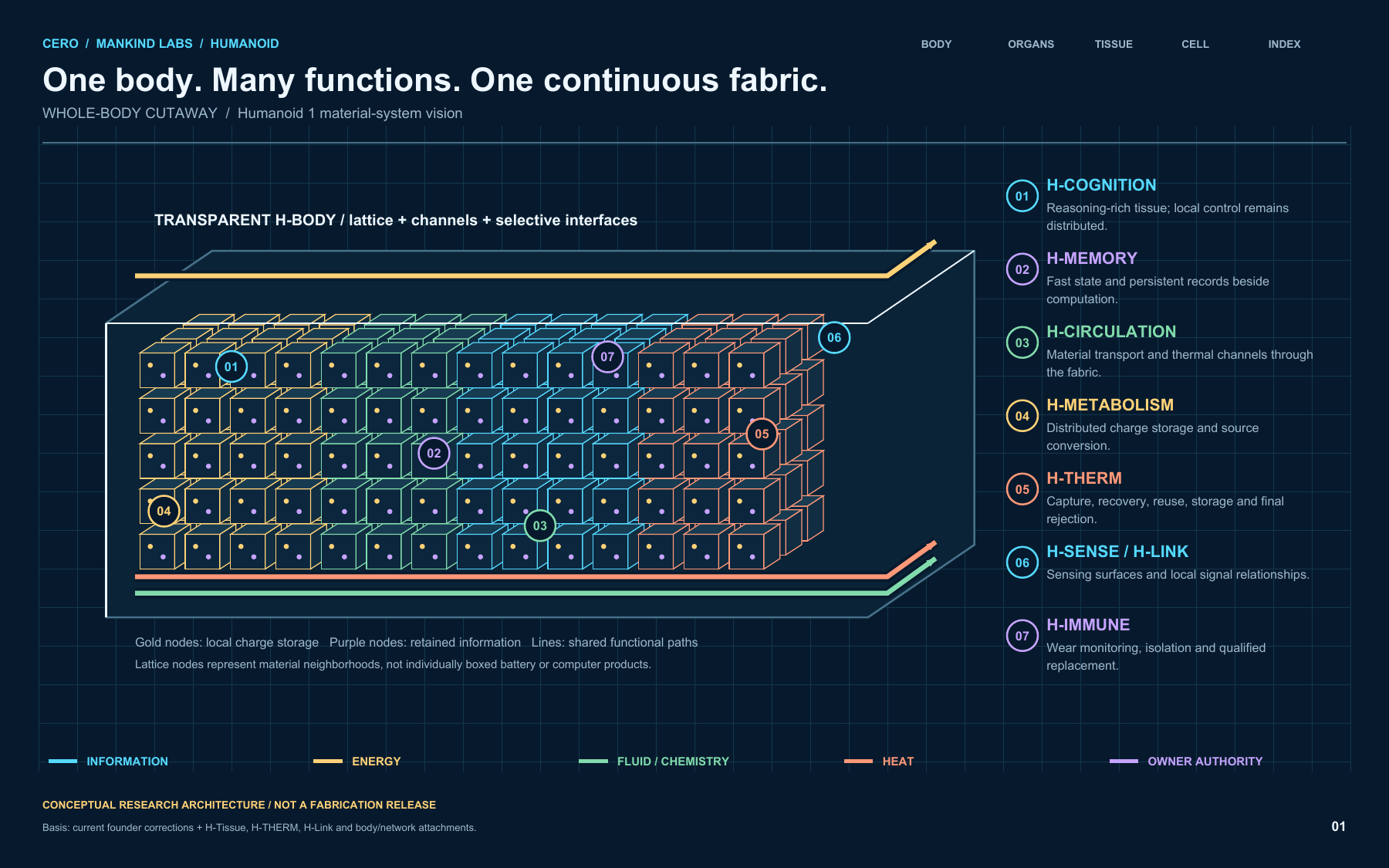
Define one useful workload, what state must survive, how machines communicate, and what the physical Cell must contribute. Resolve component and voltage interfaces before hardware release.
Load a program, execute useful work, save the result, interrupt power under controlled conditions, and recover. Measure retention, timing, energy, variation, and failure modes.
Run a defined workload across physically independent nodes. Measure communication overhead and useful output after worker loss, controller loss, and network partitions.
Compare connected learning with isolated machines and a conventional baseline. Use frozen evaluations; introduce a bad update, stale node, and interrupted connection. Test quarantine and rollback.
Move from characterized devices to repeated assemblies, controlled work instructions, traceable test results, repair procedures, and measured yield. Establish cost and customer value before scaling.
Every machine is intended to participate in a custom network for continuous learning. Local work, learning, contribution sharing, and fleet evaluation are separate activities.
Preserve sources, provenance, permissions, and a reproducible candidate update.
Check benefit, regressions, compatibility, and resource cost against frozen baselines.
Roll out accepted versions gradually, retain prior state, and quarantine or reverse failures.
24/7/365 is the operating ambition, not measured availability. Initial protocol experiments can use Ethernet and Wi-Fi; Wi-Fi remains part of the electronic Cell direction. A new physical communication medium is a separate research question.
Five proposed production workstreams turn the manufacturing ambition into testable questions.
| Proposed tool | Purpose | What must be established |
|---|---|---|
| Cell characterization & test station | Measure each candidate Cell and assembly. | Repeatable measurements and acceptance criteria. The proposed first tool. |
| H-Fab printer | Explore layered material deposition. | Compatible materials, curing, interfaces, and working coupons. |
| Junction fabrication tool | Investigate controlled oxide-junction fabrication. | Device repeatability and qualified processing; cleanroom replacement is unproven. |
| Tissue integrator | Explore assembly of larger connected regions. | Working constituent devices and verified electrical, thermal, and mechanical interfaces. |
| Factory data system | Connect process history, inspection, and test records. | Traceability and controlled feedback from measured production results. |
These are proposed tools under specification, not completed production machines. The manufacturer handoff and electrical design checks come before a fabrication release.
The next funding scope should connect engineering time, physical testing, independent reproduction, and manufacturer review to a specific acceptance gate.
Supplier quotes, process yield, production economics, and validated customer demand remain to be established.