
 By Treavor English
What happened
Scientists have two competing explanations for how Mars got its moons. Japan has sent a spacecraft to bring part of one back so they can test them.
The mission, Martian Moons eXploration, or MMX, launched from Japan on October 20 local time. It was still October 19 in U.S. Eastern daylight time.
JAXA, Japan’s space agency, confirmed separation from the rocket roughly 71 minutes after liftoff and injection into the planned orbit.
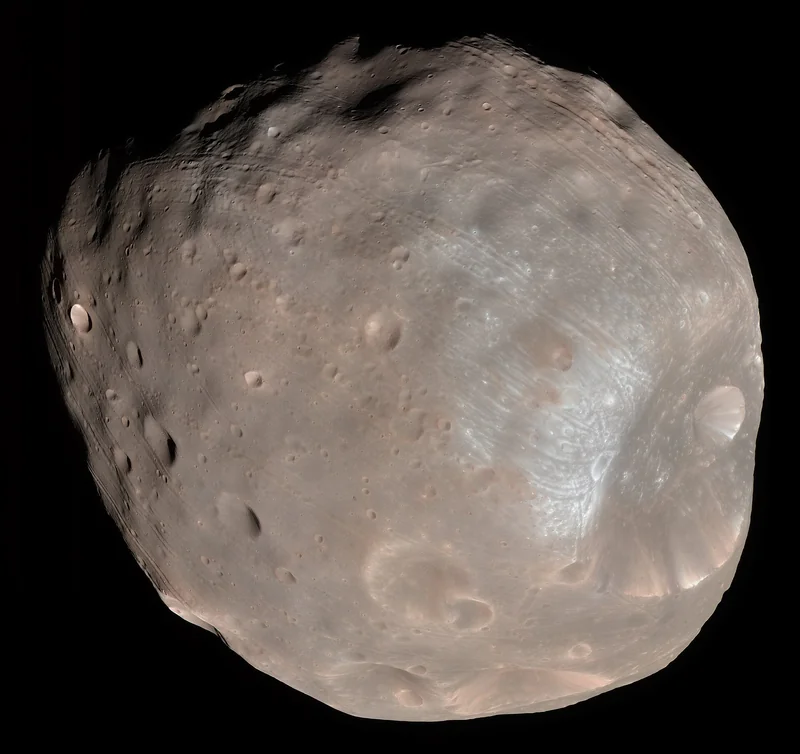
Phobos and Deimos might be asteroids caught by Mars’ gravity. Or they might have formed from material thrown into orbit by a huge impact.
The rock is the reason for the trip
Images reveal shape and surface features. Instruments can help identify composition. Bringing material back allows further tests with laboratory equipment that does not have to survive launch, fit on a spacecraft or work millions of miles from its operators.
NASA is contributing an instrument that examines gamma rays and neutrons from the surface. Its job is to identify the elements present. That lets researchers connect the material they encounter with the question of where it came from.
The U.S. agency is also helping with a sampler that uses bursts of gas to collect material, along with communication and navigation support. These are parts of a Japanese-led mission.
The hard part happens after the launch coverage
The mission targets arrival in 2027, sample collection no earlier than 2028 and return to Earth in 2031. The spacecraft still has to complete each stage.
JAXA’s reports on spacecraft health and completed maneuvers will show how the mission is progressing. Technical problems or revised dates could change the path to collection and return.
An answer worth waiting for
The material could support one explanation, weaken another or reveal something neither fully explains. Researchers can revisit the sample as new questions and testing methods emerge.
MMX has launched. The mission targets a return in 2031 with material that could help explain how Mars got its moons.
Sources & reporting notes
- Launch result of the Martian Moons eXploration spacecraft aboard H3 flight No.10
Japan Aerospace Exploration Agency · 2026-10-20 JST
Reporting note
Actual launch, spacecraft separation and injection into the planned orbit.
Main report
- NASA to Help Unlock Mysteries of Mars’ Moons in Upcoming Mission
NASA · 2026-10-15; checked 2026-10-20
Reporting note
Scientific objectives, NASA contributions and planned arrival, sampling and return milestones.
Mission objectives; MEGANE and P-Sampler; corrected timeline
- Japan launches MMX Mars mission
Associated Press · 2026-10-19 US / October 20 Japan
Reporting note
Independent coverage of the launch.
Linked report; syndication hosts retain the original newsroom attribution.
- Japan launches mission to return samples from Mars moon
Reuters · 2026-10-19 US / October 20 Japan
Reporting note
Independent Reuters launch reporting, syndicated by Yahoo.
Linked report; syndication hosts retain the original newsroom attribution.
- Japan launches mission to collect Mars moon samples
ABC Australia · Natalie Whiting and Akane Saiki · 2026-10-20
Reporting note
Separate reporting from Tanegashima on the launch and mission.
Linked report; syndication hosts retain the original newsroom attribution.
AI assisted with research, drafting and editing. Read our ethics & AI-use policy.
Story details
- Event
- October 20, 2026 JST / October 19 EDT launch
- Published
- October 20, 2026 at 12:00 AM EDT
- Sources checked
- Oct 20, 2026
- Updated
- October 21, 2026 at 12:00 AM EDT
The story, Treavslated
Source records checked October 20, 2026
How this story was made
Prepared with AI assistance using the linked records and independently published reporting. No interviews or field reporting were conducted. Worked examples and explanatory analogies are identified; editorial judgments appear separately as commentary. Wire-service syndication is counted as one newsroom, regardless of the host.
Corrections and updates
- 2026-10-20 Reworked the headline, introduction and reading guidance to explain the story for readers without prior background. Underlying source records retained.
- 2026-10-20 Expanded the explanation, added independent newsroom coverage with event/background distinctions, and retained the original source record. Illustrative examples are labeled.
- 2026-10-20 Reworked the headline and explanation in the owner’s Hardcore News voice; expanded context, mechanisms and practical consequences, with source links preserved and supplemented. Original event and publication dates retained.
- 2026-10-20 Refined the headline to reduce profanity while retaining the story’s meaning. Reporting and original publication date unchanged.
- 2026-10-20 Readability revision: shortened and clarified the explanation, consolidated repeated caveats, and added a practical Bottom line. Headlines, figures, quotations, original publication dates and source links preserved.
- 2026-10-21 Editorial revision: published the recovered rewrite, revised headline and summary, clarified numerical examples, and removed repetitive framing. Source records and original publication date retained.
- 2026-10-21 Editorial repair: removed repeated explanations and unnecessary framing so the reporting advances. Preserved the remaining factual claims, source records, material qualifications and original publication date. This copy edit does not claim new reporting or independent verification.


Comments
No comments yet.